This past weekend, my 16th-century Italian scenic experiment stepped fully into the world.
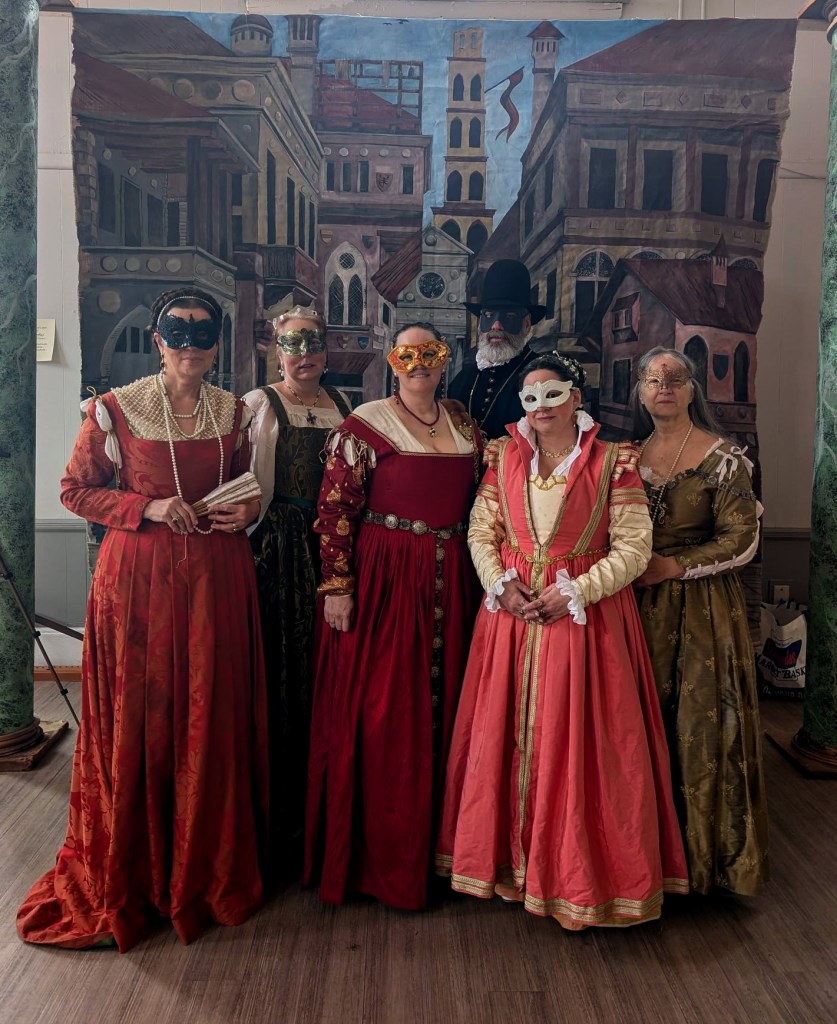
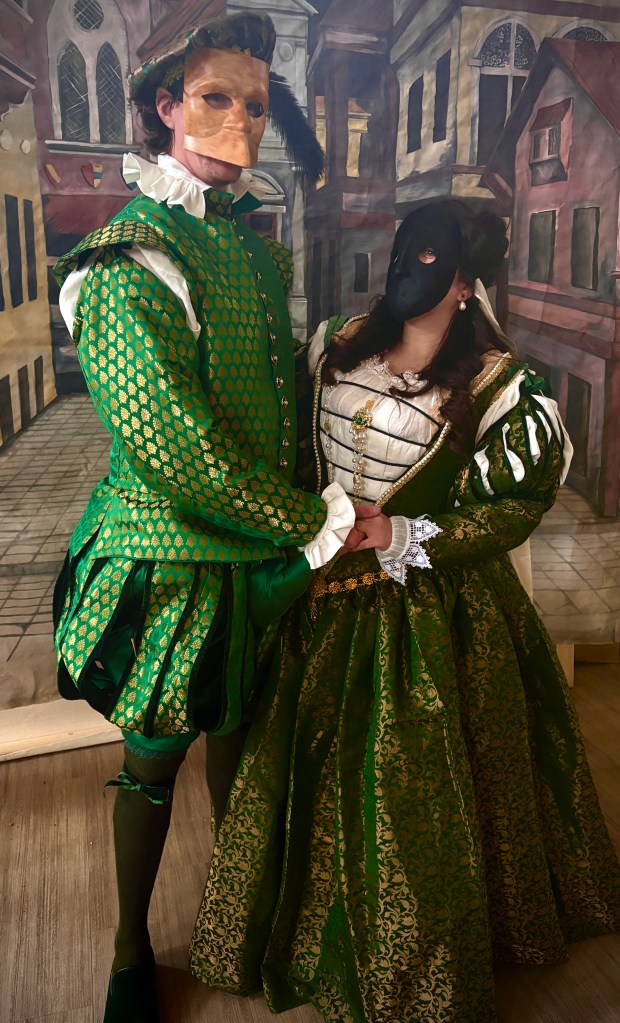
After months of research, brush making, pigment grinding, cartooning, pouncing, and painting, I was able to display my finished Renaissance backdrop at the Barony of Settmour Swamp’s immersive Venetian Carnevale event. Watching attendees in their extraordinary Italian Renaissance garb gather in front of it… laughing, posing, adjusting masks, living inside the illusion… was one of the most satisfying artistic moments I’ve experienced in the Society.
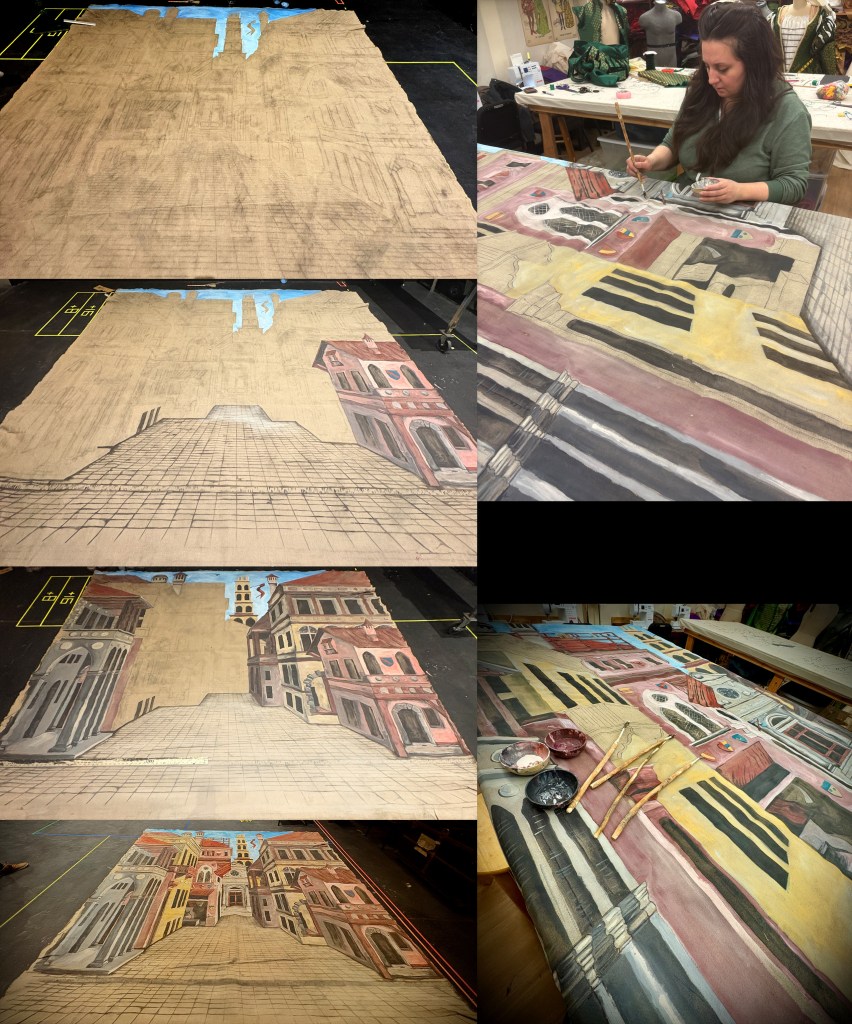
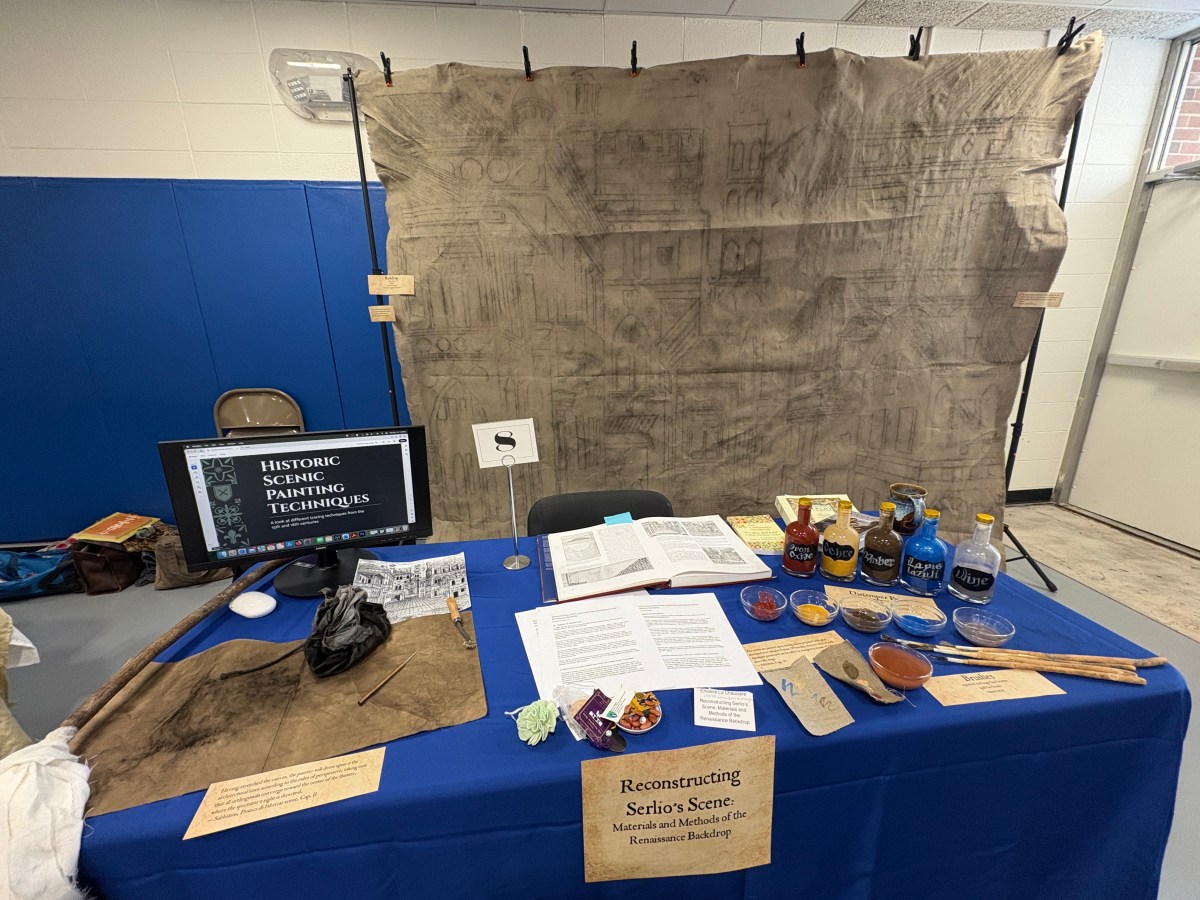
This project began with texts: Serlio’s perspective scene, Sabbatini’s technical instructions, Vasari’s workshop descriptions, and Cennini’s practical recipes. From there it moved into material experimentation: hand-bound squirrel-hair brushes, glue-size distemper, chalk whites, umbers, and lamp black. I gridded and scaled Serlio’s comic scene, pricked the cartoon, and transferred it to sized linen using the spolvero method. And then, slowly, brushstroke by brushstroke, the illusion emerged.
Seeing it used as it was intended as a social, theatrical, shared space completed the circle.
Lessons Learned & Observations
Painting on the glue-sized linen was an entirely different physical experience than the cotton muslin I typically use in modern theatre. The weave was coarser, and resting my hand against it for long stretches left my skin rubbed raw. It made me think deeply about historical working methods. Since at least the 19th century (likely earlier), scenic artists have painted standing up with brushes lashed to long poles (something I teach my students to preserve their backs and gain distance from their work). Now I’m wondering whether that technique also helped protect painters’ hands from abrasion on rougher surfaces.
My homemade distemper behaved beautifully… for about two weeks. After that, it began to separate and, in a few cases, ferment. Several bottles I reopened late in the process popped their corks like champagne and smelled absolutely dreadful. It was a vivid reminder that these materials are alive in a way modern acrylics are not. Timing matters.
I also discovered something fascinating when revisiting Serlio’s original drawing months after completing my cartoon. Using a different source edition, I noticed subtle variations: a lion in one heraldic cartouche became what looked like a lobster in another; small architectural details shifted. Were these intentional revisions by Serlio? Variations introduced in later printings? The result of making copies of copies over centuries? It’s a reminder that even our “primary sources” have histories of transmission.
Color-wise, the distemper dried chalky and matte, as expected with calcium carbonate. It watered down beautifully into translucent washes exactly as later scenic texts describe for glowing windows and atmospheric depth. I thought I would need more black than I had prepared, but the natural depth of the umber carried most of the shadow work. In fact, there is almost no true black in the finished piece. The result is softer, warmer, and more natural than if I had leaned heavily on lamp black.
Gratitude
My deepest thanks to the Barony of Settmour Swamp for dreaming up such a rich and immersive Venetian Carnevale, and for giving this drop a home. Thank you to the event stewards, the decorators, the performers, the cooks, and every attendee who stepped into the scene and made it feel alive.
And thank you to the many Renaissance artists whose documentation has survived: Serlio, Sabbatini, Vasari, Cennini for leaving us enough breadcrumbs to attempt this work centuries later.
As both a modern scenic designer and a medieval reenactor, I felt profoundly connected to that lineage.
What’s Next?
I would love to take this piece to Crown Arts & Sciences, but I do not think circumstances will allow me to join the competition. Whether that happens or not, this project is only the beginning.
I’m already scheming new theatrical magic for this year’s Quest for Wit & Wisdom in May. There may be moving parts involved. There may be illusion. There will absolutely be research.
The workshop is never quiet for long.
Recreating a Renaissance Backdrop: My St. Eligius Experience
Yesterday I had the joy of competing in the Artisan Level Challenge at St. Eligius, hosted by the Barony of Dragonship Haven– and what an extraordinary day it was! I’m thrilled (and still a bit stunned) to share that I won my division and received the Populace Choice Award. This project has been one of…

Inside the Bardic Circle with Brógáin Ó Ríain
One of my favorite events on the annual calendar is the Black Gryphon Inn, the signature tavern event of the Canton of Gryphonwald. It’s a small, local gathering that offers an afternoon of relaxed activities, including a brewing competition, a kubb tournament, and some dancing. What makes it even more special is that it hosts…

A&S Year in Review, 2023
I know, I know… Phelippe and I have been poor about writing updates. The goal of this post is to provide some updates on recent projects (and a hint at what is coming in 2024). My lack of writing is not due to lack of activity; in fact, it is quite the opposite. In many…
 Spar, Disengage, Rosemary, and Time(s)...past