Back in February, I ended my Carnevale post with something of a promise. There may be moving parts, I wrote. There may be illusion. There will absolutely be research.
I am delighted to report that all three came true.
This past Memorial Day weekend, the Barony of Settmour Swamp hosted the 41st Quest for Wit and Wisdom “Currents of Fortune“: a maritime themed adventure that I had the extraordinary honor of autocrating. It was a weekend of sea shanties, combat tournaments, feasting, pirates, and puzzles. It was also, quietly, the next chapter in what has become one of the most creatively fulfilling research threads of my SCA life: the recreation of early Renaissance scenic practice.
But I am getting ahead of myself. Let me start at the beginning.
The Event
Currents of Fortune was built around a simple and delicious premise: the Barony of Settmour Swamp was hosting a grand maritime trade event… merchants, navigators, explorers all gathered at a bustling coastal port. What participants did not know when they arrived on Friday evening was that by Saturday morning, a company of pirates would have taken over entirely.
That company was House Ravenspittle, led by the inimitable Captain Dutch (Lucas Abernathy), whose daughter had been arrested for piracy by the Gryphonwald Navy and who had arrived to make his grievances known in the most theatrical way possible. Over the course of the weekend, the pirates oversaw our martial tournaments, commandeered the feast, and attempted, with difficulty, to run baronial court on Sunday afternoon. What began as an occupation ended as something far more moving: Dutch and his crew discovering, piece by piece, what the SCA actually is, and choosing to become part of it.
I will not pretend the weather cooperated. It rained. It rained a great deal. It rained during archery and fencing and heavy combat and arts and sciences and the artisans’ row and the brewing competition, all of which happened anyway because this community is made of remarkably cheerful and waterproof people. By the time feast arrived and warmed us all from the inside out, the general consensus seemed to be that even damp, even cold, we were exactly where we wanted to be. That is Settmour Swamp. That is why we do this.
The Quest itself: ten obstacle stations scattered around the pavilion, each with its own challenge, and a fair amount of pirate hecklers, was a genuine triumph. Teams navigated blind cargo runs and giant battleship and a cartographer’s torn map and at least one very opinionated toilet seat, collecting treasure map fragments along the way. The chest at the end, unlocked by a riddle whose answer was Quest, contained tokens representing previous Quests for Wit and Wisdom. It meant everything to the barony and absolutely nothing to the pirates, which was exactly the point.

Court was lovely. Awards were given. Pirates were officially welcomed into the barony. House Fitzgerald and the Gryphonwald Navy made a dramatic entrance. It was, in every sense, a perfect SCA afternoon.
The Wave Machine
And now for the part I have been most eager to write about.
Those of you who have been following this blog will know that my research into early Renaissance scenic practice began in earnest with the Serlio backdrop: the recreation of a 16th century perspective scene using period materials, techniques, and sources. That project took me through Serlio’s original drawings, Sabbatini’s technical instructions, Vasari’s workshop descriptions, and Cennini’s practical recipes. It involved hand-bound squirrel-hair brushes, glue-size distemper, spolvero transfer, and more than a few batches of fermented paint. It was displayed at St. Eligius, where it won its division and the Populace Choice Award, and again at the Barony’s Venetian Carnevale in February, where watching attendees step into the illusion and live inside it for an afternoon was one of the most satisfying artistic experiences I have had in the Society.
But Sabbatini, as those of you familiar with him will know, was not only interested in painted scenery.
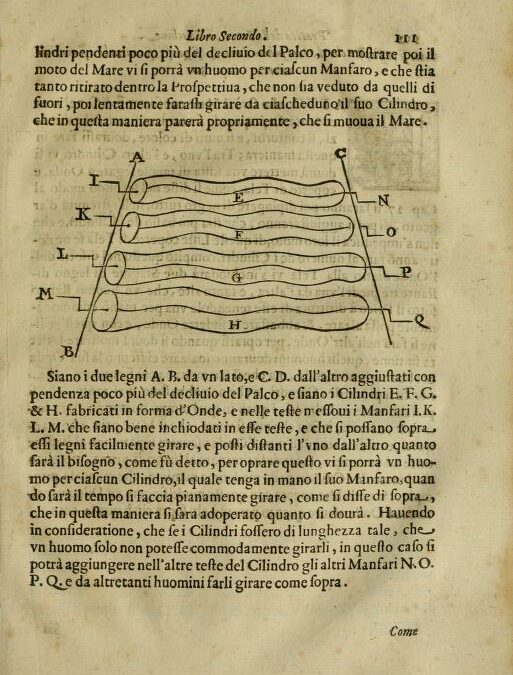
Nicolas Sabbatini’s Pratica di fabricar scene e machine ne’ teatri, published in 1638, is one of the most remarkable documents in the history of theatre. It is a catalog…meticulous, practical, illustrated…of the scenic devices and theatrical machines being created by the earliest professional stage designers. Perspective drops. Transformation effects. Cloud machines. And, crucially for our purposes: wave machines.
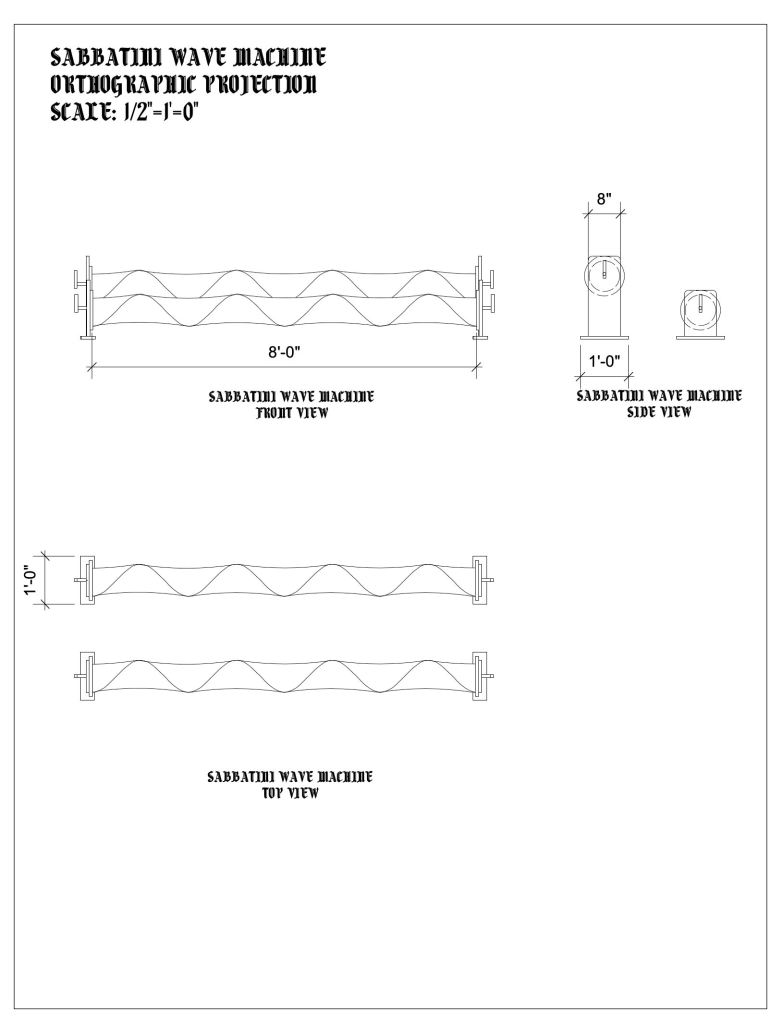
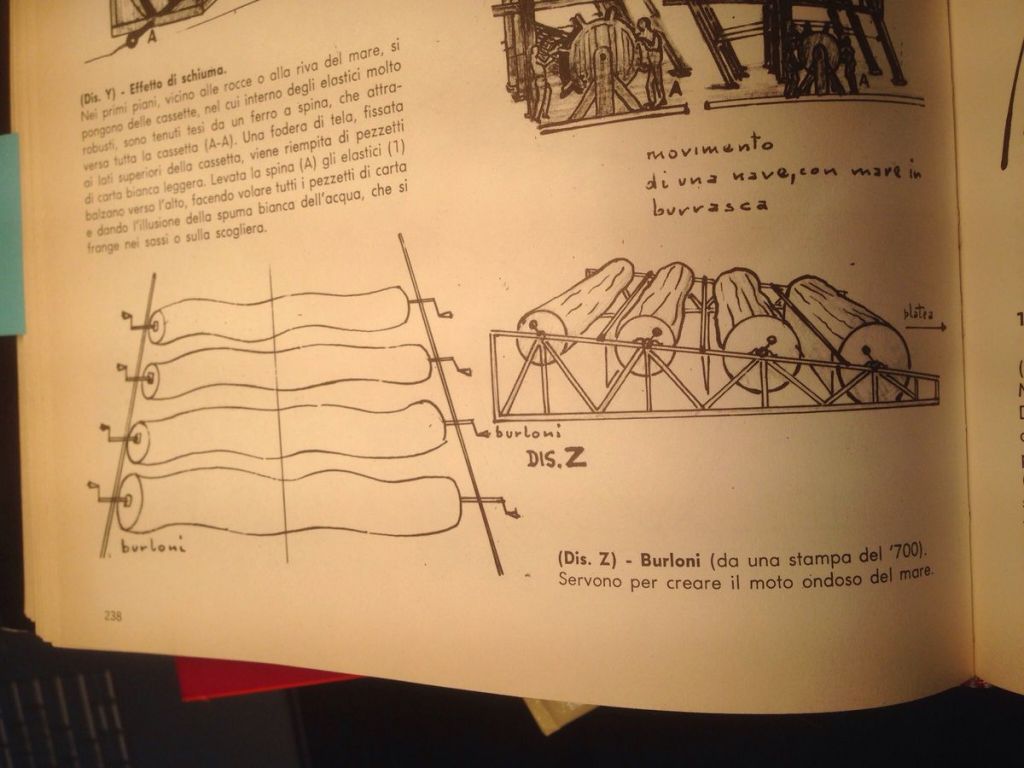
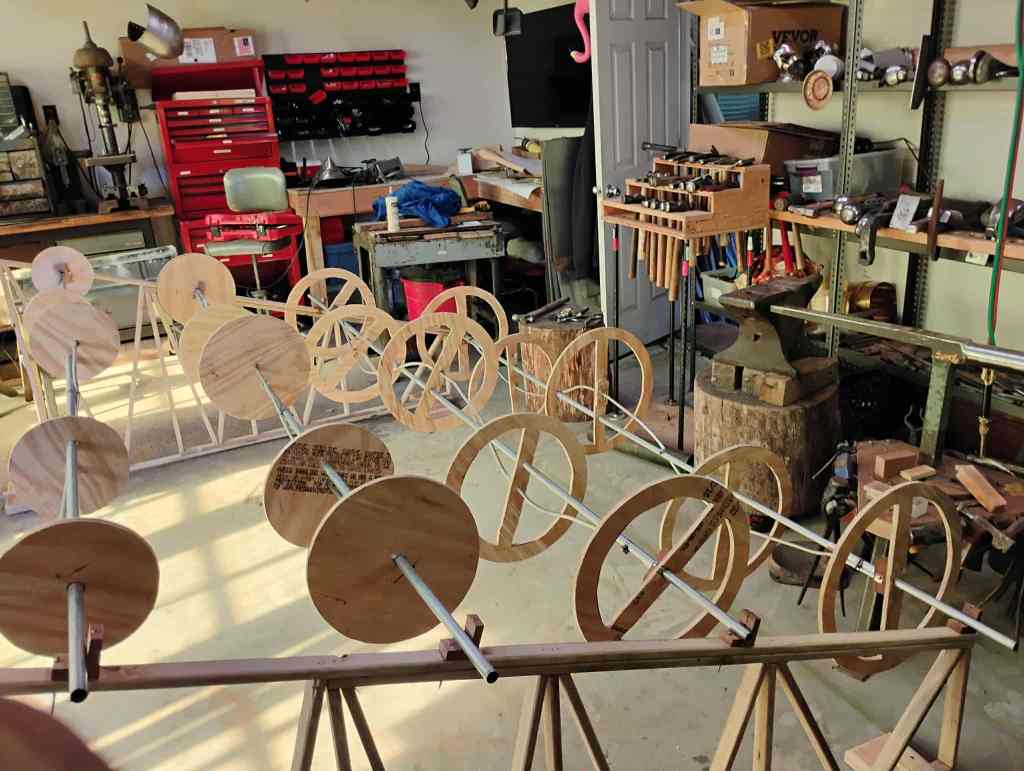
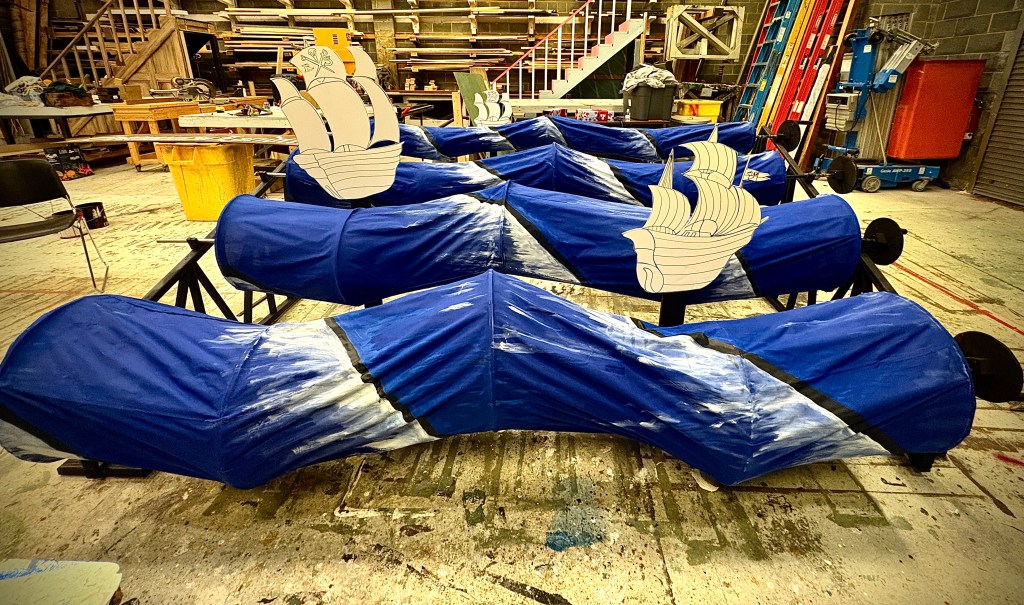
Sabbatini describes in careful detail how to create the illusion of rolling ocean waves on a stage: a series of wooden frames, metal spirals, draped and painted, operated in sequence to produce the visual effect of a living sea. The instructions are specific. The drawings are mostly clear. And as far as I have been able to determine, no one has put this machine onstage the way Sabbatini originally intended it in centuries.
Until now.
When I knew I had the opportunity to autocrat a maritime themed Quest, I knew immediately that this was the moment. The research was there. The theme was perfect. What I needed was a collaborator.
I found the very best one in my dear friend Sir Jonathan Miles.
Jonathan threw himself into this project with a generosity and skill that I cannot overstate. He built the frames, the structural bones of the machine, working through the practical engineering challenges of translating a 17th century illustration into something that could be constructed, transported, and operated at a camping event in New Jersey in the rain. This is not a small thing. Sabbatini’s drawings tell you what the machine looks like. They do not tell you how to load it into a truck.
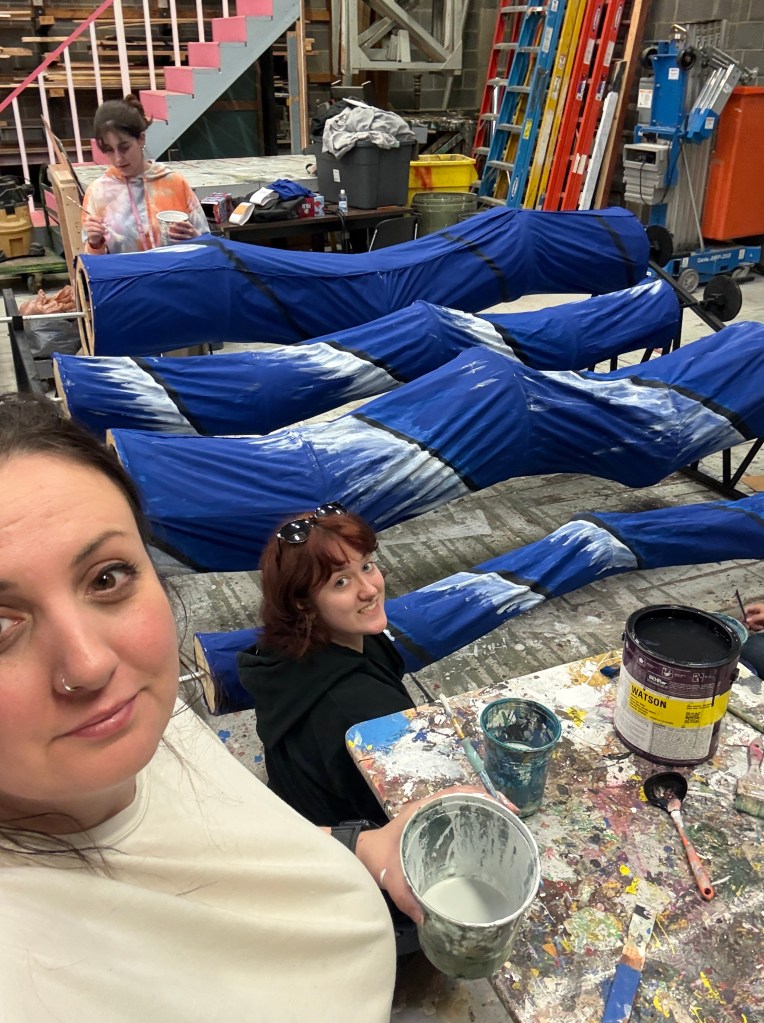
Once Jonathan had built the frames, I was able to take them into the studio with a few of my theatre students. Together we draped the fabric, sized it, and painted it (drawing on an 18th century scale model as our color reference for what a period wave machine might actually have looked like in practice). The painting itself was a joy. Waves are forgiving subjects. They move, they layer, they blend. The fabric responded beautifully.
And then we brought it to the event.
Seeing it in motion was extraordinary. Watching people interact with it, leaning over it, playing with it, posing beside it, simply standing and watching the fabric roll… completed a circle that began years ago when I first picked up Sabbatini’s text and thought: I wonder if this actually works.
It works.
What this Means to Me
I have been thinking a great deal lately about the thread that connects these projects. The Serlio backdrop. The wave machine. Whatever comes next. On the surface they are scenic art projects, research exercises, historical recreations. But I think what they really are is a conversation, across four centuries, with the artists and craftspeople who first figured out how to make an audience believe in something that isn’t there.
Serlio, Sabbatini, Vasari, Cennini. They left us their notes. Their drawings. Their recipes for paint that ferments if you leave it too long. They documented their failures as well as their successes, which is one of the things I love most about them. They were working things out in real time, just as I am.
As both a modern scenic designer and a medieval reenactor, I feel that lineage acutely. Every time I put one of these machines onstage (even in a field, even in the rain, even surrounded by pirates) I am continuing something that has been going on for a very long time. That is, I think, precisely what the SCA is for.
Gratitude
This event would not have existed without an extraordinary number of people. My co-conspirators Dutch and Renny. The patience and generosity of our partners Phelippe (Jeff) and Fiona (Christie). The setup crew who raised Settmour’s Landing from the mud. The marshals who ran every tournament in a monsoon. Martina and her feast team who warmed every cold soul in that hall. The Quest obstacle runners who committed fully to their characters. Sima and Lydia who raised several hundred dollars for Elijah’s Promise through a beautiful silent auction. All of the numerous people who helped with setup, break down, troll, etc. Baron Orlando and Baroness Charis, who trusted me with this opportunity and spent Saturday evening on very small stools with extraordinary grace. And Vivian, who listened to me tirelessly about these projects.
And, of course, Jonathan Miles, who built the bones of the wave machine and never once questioned why we were doing this. He already knew.
And lastly, Phelippe (Jeff), my loving, patient, endlessly good-humored husband, who drove giant fabric tubes around on the roof of our truck and asked very few questions. He is, as ever, the best of collaborators.
And now enjoy the wave machine for yourself…

